Creativity Belongs in the Science and Math Classroom, Too!
Why hands-on exploration, experimentation, and creative thinking matter—even in high school.
When we think about creativity in education, our minds often go straight to art projects, creative writing, music, or elementary classrooms filled with colorful activities. But what about high school physics? Chemistry? Geometry? Middle school science? Does creativity still have a place when students are learning equations, analyzing data, and tackling complex scientific concepts?
Absolutely! And I would argue that it’s just as important in these classrooms as anywhere else.
Throughout my years of teaching, I’ve found that some of the most meaningful learning experiences happened when students were given an opportunity to explore, experiment, construct, question, and discover. Sometimes those activities were carefully planned investigations with detailed data collection and mathematical analysis. Other times? I handed students a few toy cars, some track, and a roll of tape.
Both approaches had a purpose.
Creativity Doesn’t Mean Abandoning Academic Rigor
One of the misconceptions about creative classroom activities is that they’re simply a way to make learning more fun. And while I certainly believe learning should be enjoyable, fun isn’t the primary goal. Understanding is the goal.
A creative activity should provide an opportunity for students to engage with an idea, investigate a concept, test a theory, or apply their understanding in a meaningful way. Sometimes that means collecting data, constructing graphs, and completing calculations. Other times it means asking questions, making observations, discussing unexpected results, and discovering how something works.
There’s room for both. In fact, I believe some of the best lessons combine them.
Sometimes Physics Needs a Few Toy Cars
High school physics is a wonderful subject, but it can also be incredibly math-heavy. Students spend a great deal of time working with formulas, solving equations, converting units, and analyzing relationships between variables. All of that is important. But I’ve also watched students become so focused on manipulating equations that they lose sight of what they’re actually trying to understand.
That’s when it’s time to change the approach.
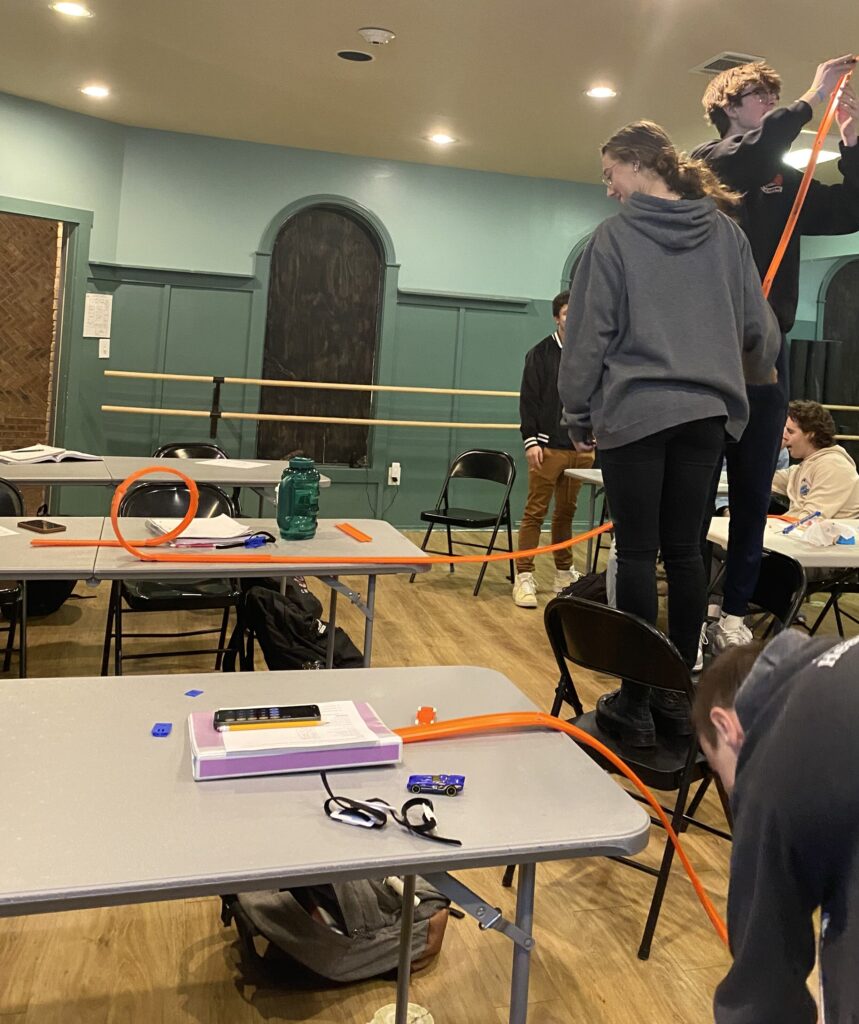
Imagine handing a group of students some toy cars, a few pieces of track, tape, and simple building materials. What happens when two cars collide? What changes when one car has more mass? How does the motion change when the direction changes? What happens when students adjust the track?
Suddenly, momentum, mass, speed, and velocity aren’t just vocabulary terms or variables in an equation. They’re things students can observe, investigate, and discuss. They begin making predictions. They test their ideas. Sometimes they’re surprised by what happens. And those surprises often lead to some of the best conversations.
Later, when we return to the equations, students have experiences they can connect to the mathematics. The numbers begin to represent something real.
Discovering the Science of a Pendulum or Springs
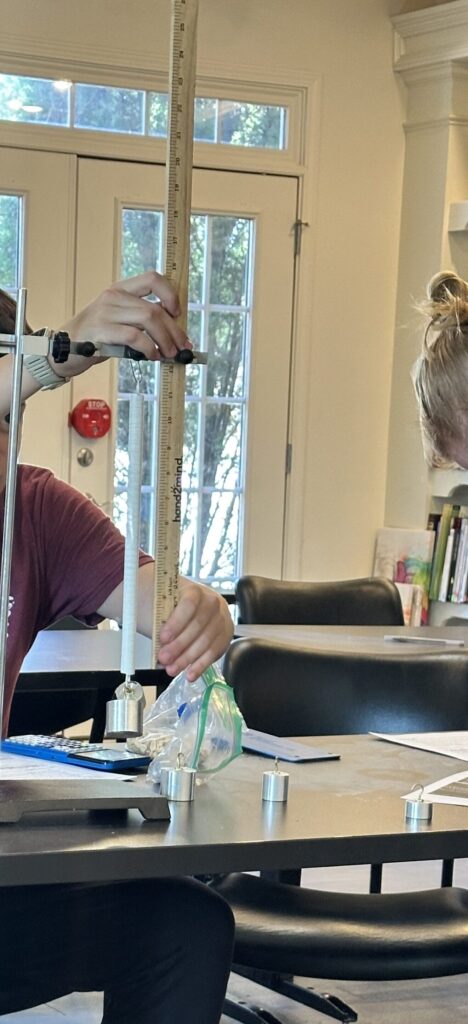
Pendulums and springs provide another wonderful opportunity for exploration. Students can construct simple pendulums using string, weights, and readily available classroom materials, or investigate how springs behave when different masses are suspended from them. Then they can begin investigating. Does changing the mass affect the time it takes for a pendulum to swing? What happens when the string is longer? Does the release angle make a difference? How does the amount a spring stretches change as more mass is added?
Rather than simply telling students the relationships, let them experiment. Students can make predictions, observe results, compare their findings, and work toward explanations. And when they’re ready for the mathematics, there’s a real experience behind the formula.
💡 GoAlongs Teaching Tip:
Not every exploration needs to begin with a formal lab sheet. Sometimes a few guiding questions and a classroom discussion provide exactly the structure students need.
Build a Catapult, Then Make It Better!
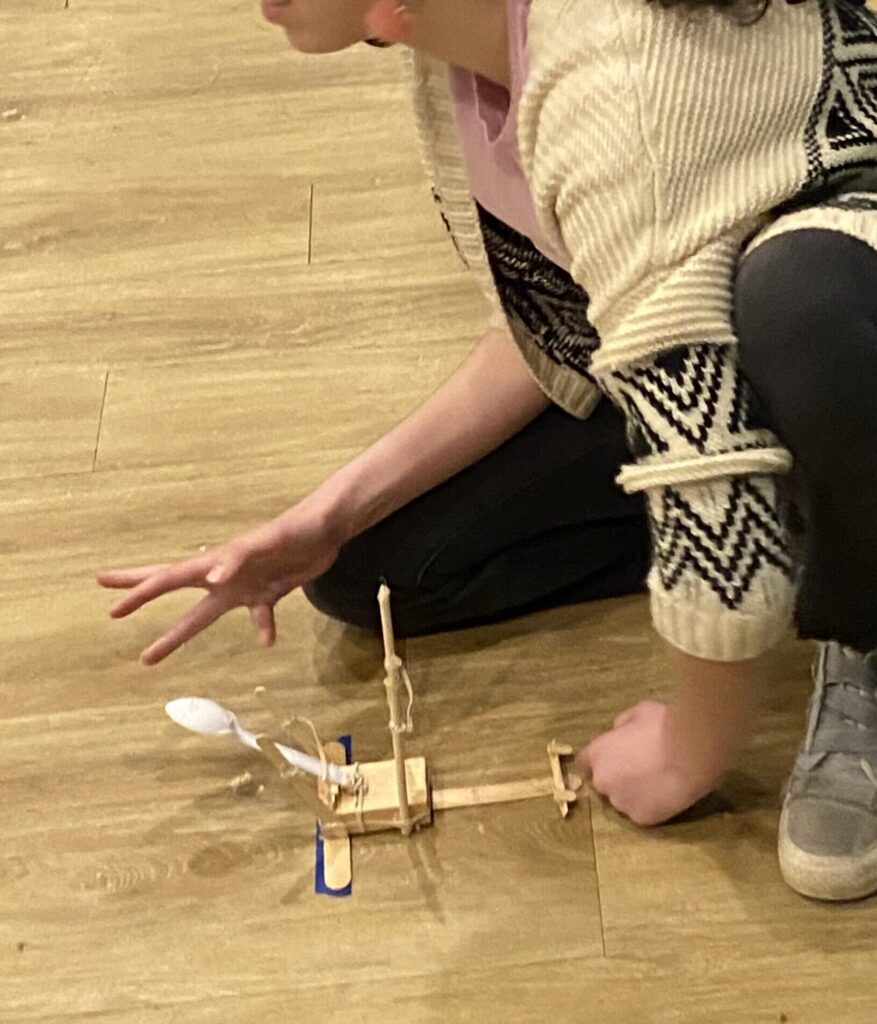
One of my favorite ways to encourage creative problem-solving is to give students a collection of materials and a challenge.
Consider a lesson involving projectile motion. We could provide students with a catapult, ask them to vary the launch angle, and have them calculate or measure the resulting distances. That would be a perfectly reasonable investigation.
But what if we take it one step further? Give students a pile of supplies and challenge them to design and construct their own catapult. Now they’re making design decisions, solving construction problems, testing their creations, and adjusting their approaches. Once their catapults are working, challenge them to determine how to achieve the greatest possible launch distance.
Students quickly discover that their first design may not be their best. They modify. They test. They compare. They try again. And along the way, they’re exploring force, energy, launch angle, projectile motion, and the value of repeated experimentation. They’re also practicing perseverance, collaboration, and creative problem-solving. There’s a tremendous amount of learning happening before anyone even picks up a calculator. Of course, this activity can also lead directly into mathematical modeling and data analysis.
Creative exploration and mathematical rigor aren’t opposites. They can reinforce one another.
Geometry Doesn’t Have to Stay on Paper
Creative teaching isn’t limited to science.
Consider a geometry lesson on transversals and the angles formed when lines intersect. Students can certainly learn the relationships through diagrams and practice problems. But imagine using painter’s tape to create intersecting lines across classroom tables or even the classroom floor.
Students can work in groups to identify, mark, and label the angles. They can discuss corresponding angles, alternate interior angles, supplementary angles, and the relationships created when parallel lines are intersected by a transversal. Suddenly, students aren’t just looking at a diagram in a textbook. They’re standing around a model they’ve helped create, discussing relationships with classmates, and physically identifying the angles.
As the teacher moves around the room, there’s an added benefit. You can listen to those discussions. You can observe which students understand the relationships and which students need additional support. And you can address misconceptions as they happen.
The activity becomes more than a different way of presenting the material. It becomes an opportunity for participation, peer learning, and informal assessment.
Chemistry, Ice Cream, and a Little Friendly Competition
One of the most memorable ways to teach freezing-point depression is to make ice cream.
Yes, ice cream!
Students investigate how adding salt to ice affects the freezing temperature of the mixture surrounding their ice cream ingredients. What starts as a fun classroom activity can quickly become a genuine scientific investigation.
Students begin experimenting with the amounts of salt and ice, monitoring temperatures, and comparing results. And sometimes things get competitive! Groups want to see who can achieve the lowest thermometer reading or produce the best frozen mixture. They’re making observations, testing variables, and discussing why their results differ. And they’re experiencing a chemical principle in a way that is difficult to forget.
The lesson can include temperature graphs, calculations, and a more formal investigation if those elements support the learning objectives. Or it can serve as an introductory exploration before students begin studying the calculations.
The important part is that the activity has a purpose beyond making ice cream. The students are discovering something about how the world works.
(And getting to eat the results is a pretty nice bonus!)
Not Every Activity Needs a Worksheet
I love a well-designed laboratory investigation. There’s a time and place for detailed procedures, organized data tables, graphs, calculations, and written conclusions. Those skills matter, especially as students prepare for more advanced science courses.
But I don’t believe every hands-on classroom experience needs to become a formal laboratory exercise. Sometimes the purpose is simply to explore. Sometimes it’s to introduce an unfamiliar concept. Sometimes it’s to challenge an assumption or spark a question. And sometimes it’s to give students an experience they can draw upon when the lesson becomes more abstract.
The structure should support the learning objective—not overwhelm it. A thoughtful question, a few materials, and a meaningful challenge can accomplish a great deal.
Creative Activities Help Teachers See Student Thinking
One of the less obvious benefits of hands-on learning is what it reveals to the teacher. When students are actively working through a challenge, you have opportunities to observe their thinking in ways that aren’t always possible during a lecture. Listen to their discussions. Notice what they predict. Watch how they respond when an experiment doesn’t work as expected. Pay attention to how they explain their results to one another.
Those moments can reveal misunderstandings, partial understanding, and unexpected insights. They also create opportunities to ask questions that push students a little further.
Why do you think that happened? What would happen if you changed this variable? How could you test that idea? Does your result support your prediction?
These conversations are part of the learning process, and they can be incredibly valuable.
Learning Is More Than Remembering a Formula
I want students to know how to solve problems. I want them to understand equations, interpret data, and use mathematics confidently. But I also want them to understand what those equations represent. I want them to ask questions, recognize relationships, develop explanations, and apply what they’ve learned to unfamiliar situations. And I want them to remember the experience of discovering something for themselves.
Will every student remember every equation from a physics course years later? Probably not. But they may remember building a catapult, experimenting with pendulums, or discovering why their toy car behaved differently than they expected.
Those experiences can become meaningful connections to the concepts they studied. And that’s worth making room for.
Bringing Creativity Back to the Classroom
Creative learning doesn’t require expensive equipment, elaborate lesson plans, or hours of preparation. Sometimes all it takes is looking at a familiar lesson and asking:
Could students explore this idea instead of only hearing about it? Could they build something? Test something? Change a variable? Solve a problem together? Could I give them an opportunity to discover a relationship before explaining it?
Not every lesson needs to be hands-on. Not every activity needs to be open-ended. And sometimes students really do need direct instruction and plenty of mathematical practice. But creativity belongs in those lessons, too. Because creativity isn’t just about making something beautiful. It’s about curiosity, exploration, experimentation, problem-solving, and finding new ways to understand the world around us.
And those are at the very heart of science and mathematics.
Let’s Keep Exploring!
Here at GoAlongs, the LEARN section is a place to share hands-on activities, creative teaching ideas, classroom experiments, and projects that help turn abstract concepts into meaningful learning experiences.
Whether you’re teaching middle school science, high school physics, chemistry, mathematics, or learning together at home, I hope you’ll find ideas that encourage curiosity and discovery.
Because learning doesn’t have to be complicated to be meaningful. Sometimes you just need a few toy cars and a little imagination!