But I Might Need That Someday! — Confessions of a Creative Hoarder
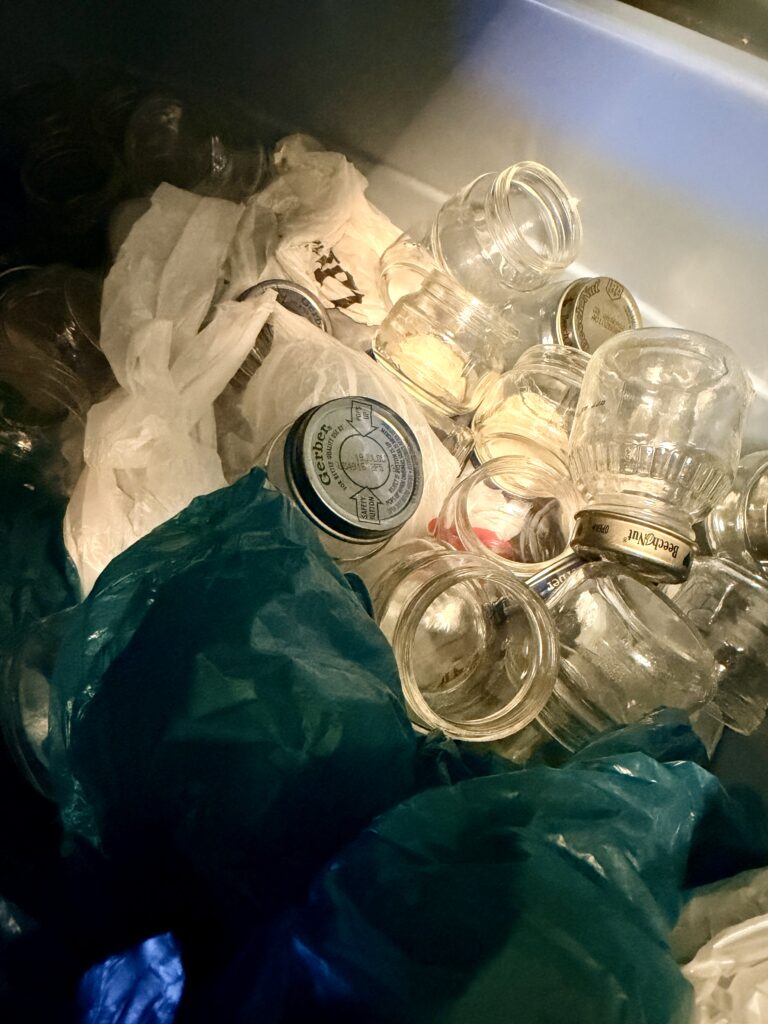
I have a confession to make. I have baby food jars that I’ve been saving since 2000. Yes, you read that correctly. 2000.
Those little glass jars have followed me through multiple moves, several creative spaces, and more than two decades of crafting adventures. And do you know what? I finally used some of them about six months ago! I needed containers for storing liquid polymer clay, and suddenly those jars I’d been saving for more than 25 years were exactly what I needed.
Vindication!
Of course, I still have about 30 more, but that’s not the point.
If you’re a creative person, you probably understand exactly why I’ve kept them. And if you’re not, you’re probably wondering why anyone would move a collection of empty baby food jars from house to house for a quarter of a century.
Welcome to the wonderful world of creative hoarding!
We Don’t See Trash. We See Possibilities.
I think creative people look at the world a little differently. Where someone else sees an empty container, we see potential storage. Where someone sees a piece of packaging destined for the recycling bin, we imagine what we might make with it. We see possibilities in everyday objects that other people might never consider.
And the most dangerous words in a creative person’s vocabulary might just be, “But I might need that someday!”
The trouble is, sometimes we’re absolutely right.
Back in 2014, I saved some clear plastic packaging because I was certain there was something useful about it. I couldn’t have told you exactly what I planned to do with it, but I knew it was worth keeping. Fast-forward more than a decade, and I’ve been using that same clear plastic in my dollhouse miniature projects!
See? I knew it would come in handy!
Now, was it worth storing for all those years? That’s a question we probably shouldn’t examine too closely. But there’s something wonderfully satisfying about turning a piece of discarded packaging into exactly the material you need for a project. It’s hard not to feel just a little smug when your instincts are finally proven right.
Apparently, It’s a Family Tradition
At some point, your family begins to recognize your creative collecting tendencies. Mine certainly has.
Years ago, my son was helping with Vacation Bible School. They had used tennis ball containers for a craft project and had about 100 empty containers left over. The plan was to throw them away, but my son immediately announced, “My mom would want those!”
And he was absolutely right.
I ended up with the tennis ball containers, along with some wooden blocks that were about two inches square. Now, you might be imagining piles of containers and blocks gathering dust in a storage closet, but here’s where the story gets interesting. I was teaching science, and both items turned out to be genuinely useful classroom materials.
The wooden blocks became part of my physics supplies. They were great when students were designing and building catapults! The tennis ball containers became wonderful vases for biology activities where we observed how colored water traveled through flowers. They also because a great replacement for a soda bottle when making balloon cars in physical science class.
What looked like trash became hands-on learning materials. And that’s one of the things I love about being creative. Sometimes the most interesting projects begin with materials that were never intended for that purpose.
I suppose the funniest part is that my children learned to recognize a potentially useful object before it ever reached the trash can. Apparently, creative collecting is something you can pass down to the next generation!
The One Time I Got Rid of Something…
Of course, there’s another reason creative people have trouble letting things go. We’ve all experienced that moment when we finally decide to get rid of something, only to discover shortly afterward that we needed it.
I once donated a shelving unit to Goodwill. I was being responsible, decluttering, and letting go of something I no longer thought I needed. I felt pretty good about my decision until the very next day, when I read a wonderful blog post showing how that exact type of grid shelving could be repurposed into a fantastic creative storage solution.
THE. NEXT. DAY.
I was so frustrated! I’d had the perfect thing sitting around, and now that I knew what to do with it, it was gone.
Experiences like that do absolutely nothing to help a creative person become better at decluttering. In fact, they tend to reinforce our belief that we should keep everything forever. Because you just never know when the perfect idea will appear, and wouldn’t it be a shame if you’d already gotten rid of the one thing you needed to make it happen?
The IKEA Scissors Rule
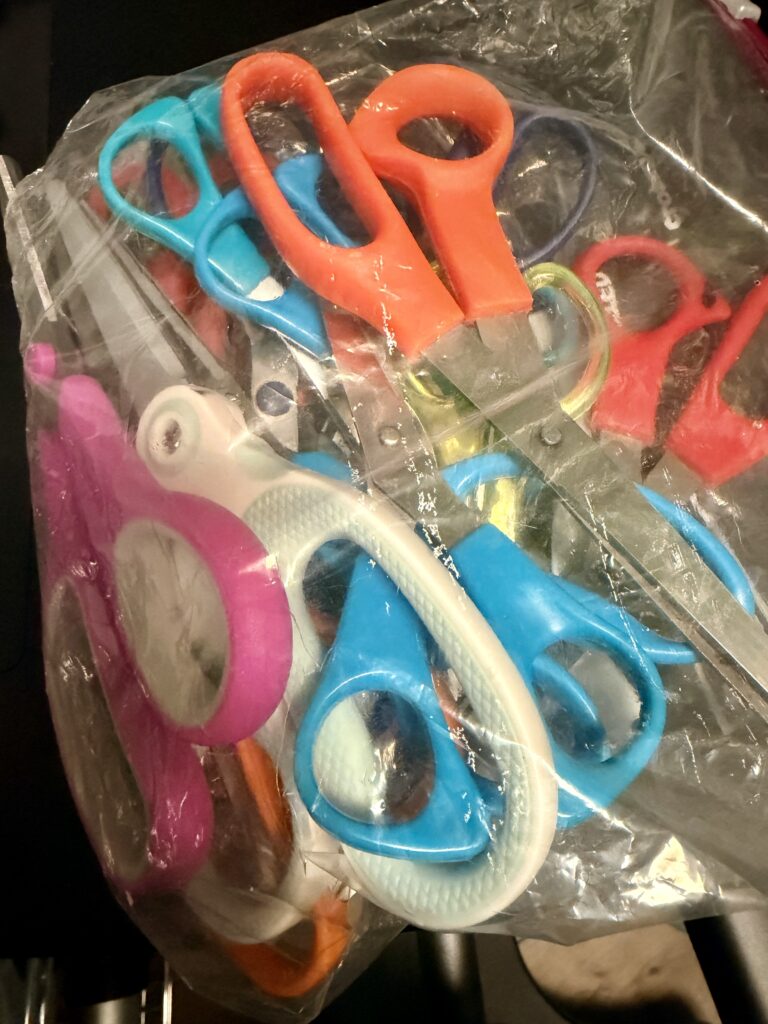
Now, not everything I collect is something rescued from the trash. Some things I intentionally buy over and over again, and one of those things is scissors.
I have a rule: You never leave IKEA without buying scissors.
Not just any scissors, either. IKEA sells an inexpensive two-pack of scissors, and they’re GOOD scissors. They don’t feel cheap, they hold up beautifully, and they’re exactly the sort of practical supply that you’ll always need.
As a teacher, scissors were practically a consumable resource. You could begin the school year with what seemed like an endless supply, and somehow they would gradually disappear. Where did they go? Nobody knows. It’s one of the great mysteries of classroom life. Even at home, scissors have an amazing ability to vanish at the exact moment you need them, so my solution was simple. Whenever I went to IKEA, I bought scissors.
My daughter grew up watching me follow this rule. About a year ago, she texted me from Florida, laughing because she’d started following my IKEA scissors rule herself. And it had already paid off! The very next day, she needed scissors. Instead of digging through boxes and trying to remember whether she’d even brought a pair when she moved to Florida, she had two brand-new pairs waiting for her.
Her boyfriend apparently didn’t understand the rule, but she did! And I have to admit, I felt a little proud.
Some family traditions involve recipes or holiday decorations. Ours apparently involves buying scissors at IKEA.
Do I hoard scissors? Absolutely. Now that I’ve retired from teaching, I may have a box containing approximately a billion pairs. But we’re not going to discuss that right now.
The Supplies That Are Too Precious to Use
There’s another kind of creative collecting that doesn’t involve saving empty jars, rescuing containers, or stocking up on scissors. It’s the supplies we buy simply because they’re beautiful.
You know exactly what I’m talking about. That gorgeous sheet of scrapbook paper with the perfect colors and design. The expensive paint you saw someone use in a project and immediately knew you had to try. The specialty material, beautiful ribbon, or unique embellishment that practically begged you to take it home.
You buy it, bring it into your creative space, admire it, and carefully put it away. Not because you don’t like it, but because you like it too much.
That beautiful scrapbook paper can’t possibly be wasted on just any project. It needs to be saved for something special, something meaningful, something absolutely perfect. And that expensive paint? You don’t want to experiment with it and risk messing up. What if the project doesn’t turn out the way you imagined? What if you waste that beautiful color on something that ends up in the trash?
So you wait. You wait for the perfect idea, the perfect occasion, the perfect inspiration. And somehow, ten years later, that beautiful supply is still sitting on the shelf, unused and possibly a little lonely.
Meanwhile, you’re creating projects with your ordinary materials because you don’t want to waste the good stuff. There’s a strange irony in that, isn’t there? We bought those beautiful supplies because they inspired us to create, and then we became so afraid of wasting them that we never created anything with them at all.
I think there’s something deeper going on here. As creative people, we can imagine all the wonderful things a material could become. A beautiful piece of paper might become an incredible scrapbook layout, a special handmade card, or part of a mixed-media masterpiece. But once we cut into it, we’ve chosen just one of those possibilities. All the other imaginary projects disappear, and suddenly we’re committed to making something real.
And real projects don’t always turn out perfectly.
Maybe that’s why some of our most beautiful supplies remain untouched. As long as we don’t use them, they still hold all that wonderful potential. We haven’t risked making a mistake or discovering that our finished project isn’t quite as beautiful as the one we imagined.
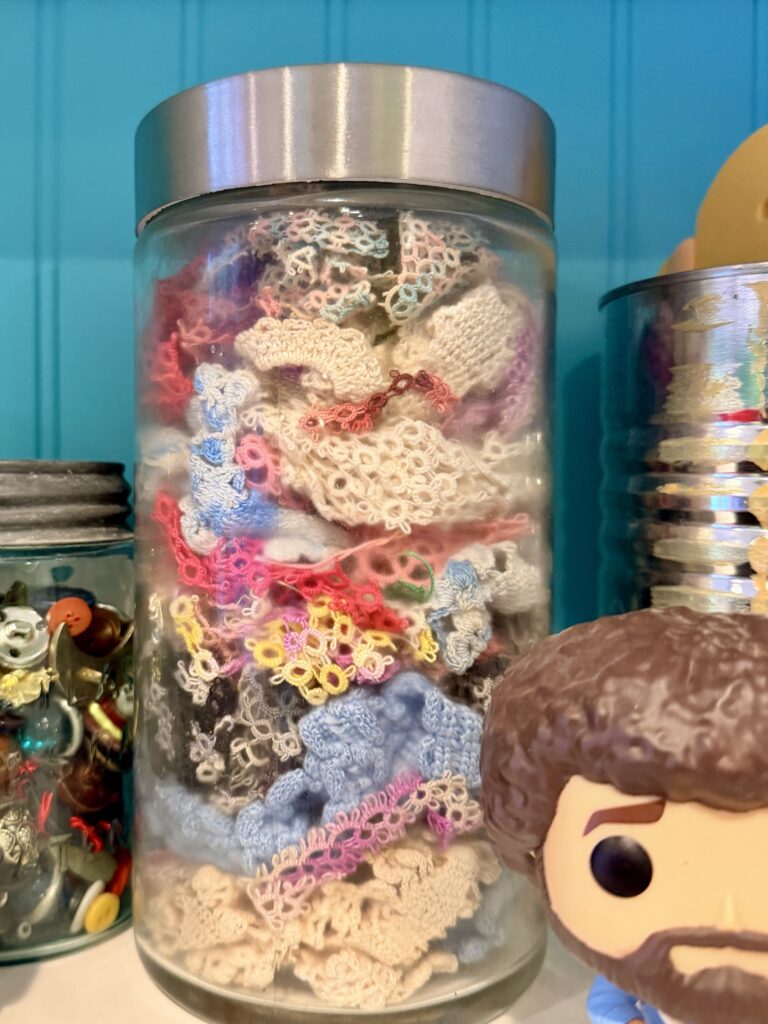
I have some beautiful hand-tatted lace that my great-aunt made about 60 years ago. Some of her tatting was used on handmade dresses sewn for me when I was a baby, and my grandmother saved the remaining pieces in a tin that became mine about 35 years ago. I always imagined using that lace on clothing I would someday make for my own children. But here I am, all these years later, still carefully saving it. Nothing has ever seemed quite special enough for something so precious and irreplaceable.
But at some point, we have to give ourselves permission to use the good stuff.
Even if the project isn’t perfect. Even if we make a mistake. Even if that beautiful paper gets cut into something that doesn’t turn out quite the way we hoped.
Because supplies aren’t really fulfilling their purpose sitting untouched on a shelf. They’re meant to become something, and maybe the perfect project isn’t the one we’ve been waiting for all these years. Maybe it’s simply the project we’re excited about making today.
When Does Collecting Become Clutter?
Of course, there is another side to this whole creative collecting business. Sometimes our ability to see possibilities in everything becomes overwhelming.
We save containers, scraps, leftover materials, specialty tools, and supplies for projects we haven’t even imagined yet. And before we know it, we have so much stuff that we can’t find the things we actually need. Or worse, we don’t have enough clear space to work on the projects we want to make.
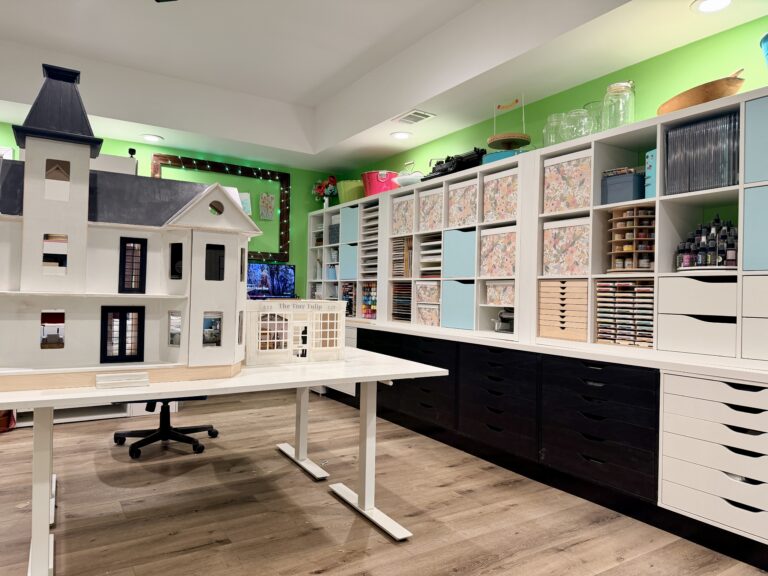
I talked about this in my article Where Do You Create?, because finding room for creativity isn’t always as simple as setting up a desk. There’s the space itself, the cost of storage, the time required to organize everything, and the sheer volume of materials we accumulate over the years. It’s possible to have a room absolutely full of wonderful creative supplies and still feel like you have nowhere to create.
And that’s when our collections stop helping us and start getting in the way.
I’m not going to pretend I’ve mastered this problem. After all, I still have 30 baby food jars, an impressive collection of scissors, and plenty of supplies that have been waiting patiently for their moment to shine.
But I am learning that there’s a difference between keeping something because I can genuinely imagine using it and keeping something simply because I can’t bear to let it go. There’s also a difference between having a collection of materials that inspires you and having so much stuff that the thought of starting a project feels overwhelming.
Perhaps that’s a question worth asking ourselves occasionally. Are we saving these things because they help us create, or are we spending more time storing and organizing our supplies than actually using them?
Maybe the Answer Is Somewhere in the Middle
I don’t think creative people need to stop seeing possibilities in everyday objects. That ability to imagine what something could become is part of what makes creating so much fun.
Without it, those wooden blocks might never have become catapult materials, the tennis ball containers might never have helped students explore plant biology, and that clear plastic packaging might never have found its way into my miniature creations.
But I also don’t think we need to save absolutely everything. Maybe the trick is learning which possibilities we’re realistically going to explore and which ones are just ideas we’re keeping out of habit.
And perhaps we should spend a little less time saving our beautiful materials for someday and a little more time actually enjoying them. A project doesn’t have to be extraordinary to deserve our favorite supplies, and a material doesn’t have to be rare or expensive to inspire something wonderful.
As for my baby food jars? Well, I’ve already found one use for them, and I’ve only got about 30 more to go. I’m sure I’ll think of something.
After all, I might need them someday!
What About You?
Are you a creative supply saver? Do you have a collection of empty containers you’ve been keeping for years, a drawer full of beautiful paper you’re afraid to cut, or a stash of supplies that only another creative person could possibly understand?
Or maybe you have your own version of my IKEA scissors rule!
I’d love to hear about it. Tell me in the comments: What’s the one thing you just can’t bring yourself to throw away?
Happy creating!
Donna